|
The Freight Buyers’ Club Briefing, 2 November 2026
Hormuz attacks hit a record as air rates climb and Europe’s €2 parcel fee kicks in
Welcome to the latest Freight Buyers' Club briefing. There's plenty going on: ship attacks in the Strait of Hormuz hit a record in October, a security guards' dispute is threatening the terminals in Los Angeles and Long Beach, and Europe's new €2 handling fee on small parcels has just come into force. Airfreight rates are still climbing into peak season on the back of strong demand and expensive jet fuel, while on the ocean side, transpacific spot rates are slipping again and carriers are struggling to make their November increases stick. And over in the US, rising insurance claims costs have knocked the share prices of two of the biggest freight brokers. Here's what you need to know.
I'm speaking at TPM27
Some news of my own: I'll be speaking alongside Nils Roche at #TPM27, the Journal of Commerce's big transpacific conference, which runs from 28 February to 3 March 2027 in Long Beach, California. TPM is where a lot of the conversations about next year's contracts really get going, so if you're heading there, come and find me and say hello. See the session
Live from IAPH in London this Wednesday
FreightSuite, the modern alternative to legacy TMS platforms, is sponsoring our coverage from the International Association of Ports and Harbors (IAPH) event in London this week, where we'll be speaking to top executives throughout Wednesday. If you're going to be there, please send me a message and let's meet up.
FreightSuite's multimodal TMS was built by forwarders who know the operator's day inside out, and reimagined with AI. Find out more here
Latest from the podcast
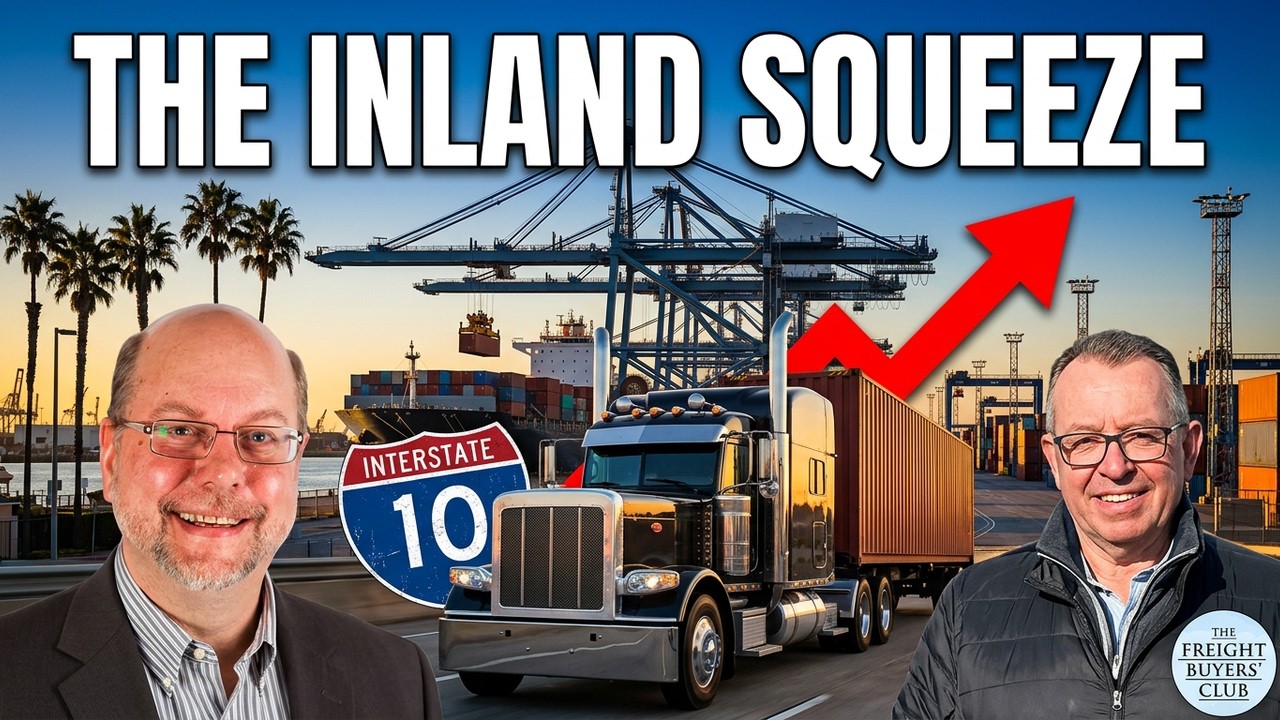
Shipping to the US? Why inland freight costs are soaring
What happens to your freight once the container is off the ship in America, and why is it costing so much more to move? In the latest episode of The Freight Buyers' Club I'm joined by Dean Croke, principal analyst at DAT iQ, and Bill Cassidy, senior editor for trucking at the Journal of Commerce, to explain what's going on in the US inland market and what it means for importers and exporters around the world.
US truck rates are up by around a third on last year, but as Dean explains, that isn't because there's more freight. The market has been repriced by a mass exodus of trucking capacity, driven by tougher enforcement on driver licensing, immigration status and English proficiency. Bill sets out what shippers are actually paying and why he sees a "K-shaped" economy shaping US freight demand, and we also get into the AI data centre boom propping up parts of the market, C.H. Robinson's $5.8bn acquisition of RXO, the $604m verdict against C.H. Robinson and what it means for carrier vetting, the shift from road to rail, the proposed Union Pacific and Norfolk Southern merger and what to expect in 2027. There are plenty of on-screen charts, so it's well worth watching on YouTube.
Sponsored by Dimerco Express Group. Watch on YouTube below or find us on your platform of choice.
▶ Watch on YouTube
Find out more about Dimerco Express Group
Container Trades Unpacked
Transpacific rates slip back as blank sailings rise. Drewry's World Container Index, the benchmark a lot of procurement teams keep an eye on, fell 3% last week to $4,429 per 40ft container, and almost all of that drop came from the transpacific. Shanghai to Los Angeles was down 6% to $7,514 per 40ft and Shanghai to New York down 5% to $9,631, while Asia to Europe held fairly steady, with Shanghai to Rotterdam up 1% to $3,686 and Shanghai to Genoa flat at $4,151.
Typhoon Champi adds to Asian port delays. Typhoon Champi closed Taiwan's container ports and airports on Friday 23 October, Freightos reports, and while it mostly spared East China before weakening, major Chinese hubs were already behind after this summer's storms, with Shanghai and Ningbo running delays of around four days, according to S&P Global. Vessels arriving in bunches are slowing the recovery, and carriers have been skipping calls to protect schedules. Shippers with cargo moving out of North Asia over the next couple of weeks should allow for knock-on delays and rolled bookings.
Strike threat hangs over LA-Long Beach terminals. Around 250 port watchmen represented by ILWU Local 26 have threatened to walk out, and served notice naming eight locations in Los Angeles and Long Beach, including APM Terminals, Long Beach Container Terminal and Total Terminals International. They're only a small share of the workforce, but according to the employers' Pacific Maritime Association, they work at terminals handling about 85% of cargo at Long Beach and a third at Los Angeles, and PMA has warned other dockworkers are unlikely to cross their picket lines. The strike deadline, originally 1 November, has been pushed back to 5pm Pacific time on Wednesday 4 November while talks continue with federal mediators, with rail delays already holding up containers in the meantime. If you've got cargo moving through Southern California, it's worth checking your forwarder's contingency plans now.
Hormuz attacks hit a record in October. Ship attacks in and around the Strait of Hormuz reached their highest level since the war with Iran began in February, with the Washington Institute counting 28 confirmed or reported attacks in October alone, according to Al-Monitor. Security analysts rate the threat in the strait as severe, which means war risk premiums and fuel costs will stay high, and both feed into what you pay.
US set to delay port fees on Chinese ships until January. The US Trade Representative has proposed extending the suspension of port fees on Chinese-owned, operated and built ships until 9 January 2027, rather than letting the pause expire on 9 November. It isn't final yet, comments closed on 30 October, and some lawmakers and maritime unions want the fees brought back. For shippers it means the fees remain a live risk for 2027 contracts, so make sure your surcharge clauses are clear about who pays if they do kick in.
Air Cargo Unpacked
Air cargo demand up 7.7% in September. IATA's latest figures show demand rose 7.7% year on year in September, well ahead of a 2.7% rise in capacity, pushing the cargo load factor up to 47.9%. Asia to North America was the standout lane with growth of 17%, while Europe to the Middle East fell 18% as the conflict continues to disrupt the region. The catch is fuel: jet fuel prices were more than double a year earlier, and IATA says yields haven't kept pace, so airlines will be looking to recover those costs through surcharges.
Air rates up 27% on last year as peak season builds. TAC Index's global Baltic Air Freight Index (BAI00) rose a further 3.9% in the week to 26 October as the market moved into its traditional peak season, leaving it 27.1% higher than a year earlier and above the peaks of the last two years.
Boeing expects air cargo traffic to double by 2045. Boeing's latest World Air Cargo Forecast says traffic should grow by about 3.5% a year over the next two decades, with the global freighter fleet rising from 2,395 aircraft in 2025 to 4,010 by 2045. It sees demand for 2,930 new and converted freighters over that time, with trade flows touching Asia making up about 60% of the market and AI hardware, e-commerce and supply chain diversification all driving growth. For buyers, the long-term message is that freighter capacity will keep expanding, but much of it will be needed just to replace ageing aircraft.
The transpacific lane that chips built. Xeneta data shows AI-related goods make up less than 10% of global air cargo volumes but are concentrated on transpacific services, STAT Times reports. Xeneta put the average global spot rate at $3.10 per kg in September, up 27% year on year. Shippers of ordinary general cargo on the transpacific are competing for space with high-value tech freight, which helps explain why rates there have held up so well.
Podcast clip: how Shein and Temu rode out Europe's end of duty-free parcels. When the US pulled its exemption for cheap parcels, Shein and Temu were left scrambling, at times flip-flopping on what they could still ship. When Europe did the same thing in July, almost nothing changed on the shelf. In this clip, Roel Gevaers, supply chain expert at the University of Antwerp, explains how they pulled that off. Watch the clip on TikTok
Overland
Shipping to the US? Why inland freight costs are soaring. In the latest episode, Dean Croke of DAT iQ explains why US truck rates are up by around a third on last year even though there's no more freight about, with a mass exodus of trucking capacity driven by tougher enforcement on driver licensing, immigration status and English proficiency. There's more on the episode in the podcast section above. Watch on YouTube
Insurance costs hammer C.H. Robinson and Landstar shares. Shares in C.H. Robinson fell 11% and Landstar dropped almost 18% after their third-quarter results, FreightWaves reports, as investors focused on higher-than-expected claims costs rather than otherwise solid numbers. C.H. Robinson's SG&A was up nearly 30% year on year, mainly because of claims, and it has raised its full-year forecast. Behind it all is the widening of broker liability in the US courts, including the large verdict against C.H. Robinson in Texas.
Supply Chain & Logistics
EU's €2 parcel handling fee now in force. Since 1 November, every small parcel ordered from outside the EU carries a €2 handling fee for each different type of product inside it, whatever its value, so a parcel with trousers and T-shirts would pay €4, Brussels Times reports. It comes on top of the temporary €3 per-item customs duty on parcels under €150 that started in July, and unlike that duty, the handling fee is permanent. The EU says it will help pay for safety checks on a flood of direct-to-consumer imports. For e-commerce shippers and the forwarders and airlines moving their freight, it's another step towards bulk shipping into European warehouses rather than individual parcels by air.
Scan Global Logistics to buy OIA Global. Danish forwarder Scan Global Logistics has agreed to buy Portland, Oregon-based OIA Global in what it calls the largest investment in its history. OIA employs more than 1,200 people across 60-plus offices in over 30 countries and had $780m in revenue last year, and the deal would put the combined group among the world's top 20 forwarders. It's expected to close in the first quarter of 2027.
UPS beats expectations and raises its outlook. UPS reported third-quarter revenue of $22.9bn and adjusted earnings per share of $1.69, and lifted its full-year guidance to around $92.6bn in revenue. Revenue per piece rose 6.1% in its US domestic business and 15% internationally, which tells you the integrators are holding firm on pricing, so shippers negotiating parcel and express contracts shouldn't expect much give.
Early Lunar New Year means planning has to start now. SEKO is advising shippers sourcing from China to place orders and book ocean freight at least four weeks earlier than usual, because Lunar New Year falls early next year, The Loadstar reports. With factory closures and the usual pre-holiday rush, anyone with spring launches or replenishment should be firming up orders and space before Christmas.
Podcast clip: why customs now wants to know your supplier's supplier. In this clip I speak with Cindy Allen, CEO of Trade Force Multiplier and a former executive director at US Customs and Border Protection, about how US trade policy has shifted from national security to what CBP and the administration now call economic security. Cindy explains why CBP wants importers of record to trace goods back through every supplier and every border they've crossed, not just the last point of origin, and walks through the four legal authorities she says the administration is using to set tariffs since the Supreme Court struck down its use of IEEPA, including forced labour tariffs she says now cover more than 60 countries. If you import into the US, supply chain mapping is fast becoming a compliance requirement rather than a nice-to-have. Watch the clip on YouTube and the full episode.
Technology
C.H. Robinson rolls its AI agents out across ocean, air and customs. C.H. Robinson says its AI agents have now produced more than 80,000 ocean and air quotes for over 3,600 customers, cutting quotes that used to take a day for air or two to three days for ocean down to two or three minutes. It's also using agents to handle ocean booking requests, starting in China in August with the rest of Asia due this quarter and global coverage expected in early 2027, and says customs document handling time is down 23%. Faster quoting is welcome, but it's worth asking any forwarder using this kind of automation how exceptions get passed to a person.
AI agents that haggle with dozens of truckers at once. Freight Technologies, the Nasdaq-listed company known as Fr8Tech, has added an "Autopilot Negotiator" to its Zayren platform that can run 20 or even 50 rate negotiations with carriers at the same time over WhatsApp, email and text, within limits set by the shipper. It's aimed at US-Mexico cross-border and domestic US road freight, and comes with an analytics tool that lets teams ask questions of their transport data in plain language. These are the company's own claims, but it shows where procurement tools are heading, with AI doing the back-and-forth and people setting the guardrails.
|